Home › Reviews › Portable Pumps › Medela Freestyle
Medela Freestyle Review: Freedom or Frustration?

Medela built the Freestyle Flex to be their most portable pump ever. They just forgot to mention how many hours it was built to last
At a Glance
Key Features
Noise Level
No official dB rating
Battery Life
~2 hours / 8 sessions
Milk Capacity
5 oz (150 ml) per bottle
Charging Type
USB (cable included)
Pump Modes
Stimulation, Expression
Warranty
1 year (motor)
Charge Time
~2 hours
Max Suction
245 mmHg
Score Breakdown
How the Medela Freestyle performs
What’s in the Box
8
Cooler bag, ice pack, 4 bottles, carry bag all included — but bustier, alternate shields, and key accessories sold separately
Design
8
Ultra-compact and palm-sized with rotating oval shields, but single Y-tube and no belt clip hurt real-world portability
Comfort
8
Oval PersonalFit Flex shields suit many body types, but only 2 sizes included and sizing fit rate is poor out of the box
Suction
7
2-Phase tech with 9 levels per phase is well-designed, but vibration-style pull and double-pump suction drop frustrate many users
Cleaning
8
Closed system, dishwasher-safe parts, 5 pieces per side — genuinely easy daily routine for a non-wearable pump
Maintenance
7
Good Medela support but 250-hour motor limit, non-replaceable battery, and expensive integrated connector parts are real long-term risks
The Good and the Not-So-Good
Pros & cons
What I loved
- 2-Phase Expression Technology
- PersonalFit Flex oval breast shields
- Battery usable while charging
- Medela Family app (Bluetooth 4.0)
- Backlit touchscreen with context-sensitive illumination
What to consider
- Noticeably loud
- Touchscreen overly sensitive
- Single Y-tube design problematic for larger chests
- No belt clip
- Essentially discontinued (Flex version)
Our Verdict
For Medela loyalists who want portability with trusted suction — lightweight cups and easy 3-part cleaning make daily use simple. Exclusive pumpers should avoid it; suction feels weaker than wall pumps and the tubing limits true freedom.
Expert 7.5/10
Mom-tested 8 ★
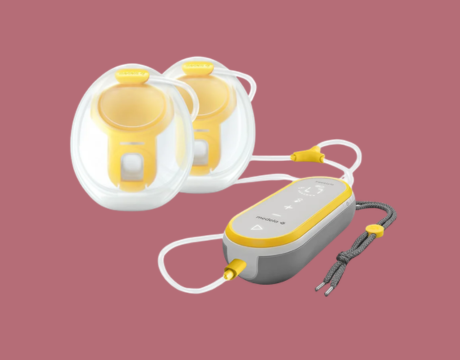
In the Box
What's included with the Medela Freestyle Flex

The Medela Freestyle Flex comes well-stocked for day-one use — no extra accessories required for most moms.
-
Motor UnitQty: 1
-
Tubing with HolderQty: 1
-
Power Adaptor with CableQty: 1
-
PersonalFit Flex Breast Shields21mm & 24mm (2 sets)
-
Connectors & Connector BodiesQty: 2 each
-
MembranesQty: 2
-
Bottles with LidsQty: 4 each
-
Bottle StandsQty: 2
-
Carry BagQty: 1
-
Cooler BagQty: 1
-
Ice PackQty: 1
Tip: The cooler bag and ice pack mean you don’t need a separate cooler from the start — a genuine addition at this price point.
Two-phase technology that works with your body

The Medela Freestyle Flex operates on Medela’s proprietary 2-Phase Expression technology, which mirrors the natural two-stage suckling pattern of a nursing baby. It begins in Stimulation Phase — a faster, lighter suction cycle designed to trigger the let-down reflex — before automatically transitioning to Expression Phase after two minutes, or immediately when you press the let-down button. The expression phase slows down and deepens the suction to efficiently draw out milk once flow has begun.
Across both phases, the pump gives you 9 adjustable vacuum levels, spanning a range of -45 to -245 mmHg at a cycle rate of 45 to 111 cycles per minute. This range is wide enough to accommodate most users, and the ability to fine-tune vacuum independently in both phases means you’re not locked into a one-size-fits-all setting.
Medela’s approach here centers on finding your Maximum Comfort Vacuum — the highest suction level that still feels comfortable — rather than pushing for maximum power, which the manual explicitly cautions against.
One caveat: the pump uses a “vibrating pull” sensation — part vibration, part suction. For some bodies, this effectively triggers letdown. For others, the vibration actually inhibits milk release. Multiple reviewers noted suction drops significantly when double pumping compared to single pumping.
Battery & Charging
Enough for a workday — but not for heavy pumpers

The Freestyle Flex runs on a built-in 3.7V / 2750mAh lithium-ion battery, delivering approximately 2 hours of pumping per full charge — enough for around six 20-minute sessions. Charging is done via the included power adaptor, and the pump can be used while plugged in, though charging slows down during active use. A three-bar battery display on the motor unit keeps you informed of remaining charge at a glance.
There are a couple of limitations worth noting. The battery is non-replaceable, meaning once it degrades over time, the entire unit needs to be replaced rather than just the battery. Additionally, if the battery fully drains, the pump won’t turn on immediately after plugging in — you’ll need to wait at least 15 minutes before it’s usable again. The pump also has a rated operating life of 250 hours, which is something heavy or exclusive pumpers should factor in.
One caveat: for occasional and on-the-go use, the battery holds up well, but the non-replaceable design and modest capacity make it a weak spot for mothers who pump frequently throughout the day.
Actually easy
Only 3 parts per side to wash — connector, flange, bottle. The closed system means milk never enters tubing. This genuinely simplifies daily cleaning, a legitimate benefit for exhausted mothers
App & Connectivity
Useful tracking, not a standout app
The Medela Freestyle Flex connects via Bluetooth 4.0 LE to the free MyMedela app, available on both iOS and Android. Once paired, the app automatically logs your pumping sessions — tracking session length, phases, and vacuum levels — and lets you manually record the amount of milk expressed. The pump stores your last 30 sessions onboard, with unlimited history saved once connected to the app.
Beyond tracking, MyMedela offers feeding guidance, daily highlights, and personalized content — though these feel more like extras than essential features. The pairing process is straightforward, multiple devices can be paired to one pump, and session data is retained even if you unpair.
It’s a useful addition for mothers who like to monitor their output and spot trends over time, but it’s not a standout app compared to what some competitors offer.
The right pump depends on how you pump
If you’re going back to work full-time
The USB-C charging is genuinely convenient — charge at your desk, in your car, from your laptop. The battery lasts 2–3 hours (4–6 sessions), easily covering a workday. It fits in a normal tote, not a giant medical equipment bag. If you have a private office, this can work beautifully.
What’s frustrating: it’s louder than competitors like Motif Duo or Spectra. Coworkers might hear it through a closed door. You must pump sitting upright — lean forward and risk spilling milk. The touch screen is overly sensitive and can change settings accidentally. Connector seams can leak if bottles tilt.
Better alternatives: Spectra S1 (quieter, stronger) or Motif Duo (much quieter, half the price) for desk pumping. True wearables like Elvie for actual discretion.
If you’re exclusively pumping
Do not plan to exclusively pump with only the Freestyle Flex. The math doesn’t work. You’ll burn through the motor in 2–3 months, then deal with repeated replacements even under warranty.
Real exclusive pumpers report: suction drops significantly when double pumping, motors dying within weeks, never fully emptying even on the highest setting, and the vibration-style suction not triggering letdown effectively.
One caveat: the membrane is integrated into the connector — you can’t replace just the membrane. When it wears out (every 4–8 weeks for heavy users), you buy the entire connector assembly at $30–60 per set. One reviewer calculated $360/year in replacement parts for exclusive pumping.
Better alternatives: Spectra S1 or Medela Sonata. Both are designed for heavy use, with no documented hour limitations and cheaper replacement parts.
If you’re pumping occasionally (1–2x/day)
This is actually the sweet spot. At occasional use, 250 hours means 2+ years of pumping. The motor will likely outlast your needs. The portability genuinely helps — toss it in the diaper bag for visits to in-laws, weekend trips, occasional separations.
Is $300–400 worth it for occasional use if you’re paying out of pocket? The Medela Swing Maxi ($160) or even a quality manual pump might serve you better. But if insurance covers it? Absolutely take it.
If you travel constantly
It genuinely fits in your palm, weighs less than a pound. USB-C means you can charge anywhere — car, plane, hotel, coffee shop. The dual voltage adapter works internationally. The 2–3 hour battery covers most travel scenarios. The closed system simplifies cleaning when you don’t have access to your normal setup.
One caveat: you cannot bend over without risking spills. You can pump while walking a hotel room, but only if you move carefully. For true unrestricted movement, wearables win. This pump is excellent for semi-mobile use — hotel room, parked car, private spaces — but not for actual hands-free multitasking.
If you’re plus-size or large-chested
The single Y-tube configuration means both flanges connect through one central tube, constraining your chest positioning. Multiple reviewers noted: heavy bottles drag breasts down painfully, you can’t pick up your baby while pumping, and wires and bottles interfere with movement.
Better alternatives: Pumps with independent tubes for each side (Spectra) or the Freestyle Hands-Free with collection cups that distribute weight differently.
What you'll actually spend
Base price: $300–400 retail (when available), often free through insurance.
What’s NOT included but you’ll need:
Pumping bra for hands-free: $30–60
Correct flange sizes (70% chance included sizes don’t fit): $20–30
Real first-year cost for exclusive pumper: Pump ($350) + flanges ($30) + bra ($40) = $420
Great for you if…
- Insurance covers it (free/low cost)
- Pumping 1–3 times per day (not exclusively)
- Need genuine portability and USB charging
- Have private pumping space (noise okay)
- Understand the 250-hour limitation
- Have backup options if it fails
- Can sit upright while pumping
- Respond well to Medela suction style
Skip it if…
- Exclusively pumping (motor won't survive)
- On tight budget paying out-of-pocket
- Plus-size/large-chested (design issues)
- Need discretion in shared spaces
- Noise is a concern
- Need reliability over 6+ months of heavy use
- Can't afford pump failure during your journey
Final Verdict
Conclusion
The Freestyle Flex isn’t the worst pump out there. It’s also not appropriate for every mother who sees it as an option.
What Medela got right: Closed system cleaning, PersonalFit Flex comfort for many, USB-C convenience, genuinely compact size, good customer service for replacements.
What Medela got wrong: 250-hour motor lifespan inadequate for exclusive pumping, expensive non-separate replacement parts, leak-prone connectors, motor failure reports too frequent, marketed to “mothers who pump several times a day” while engineering a motor that can’t survive that use case.
The sweet spot user: Working mother pumping 2-3x/day, needs portability, has insurance coverage, understands limitations, has backup options. This mother gets 6-9 months of use, by which point baby’s eating solids and pumping decreases. The convenience genuinely helps her.
Who gets left behind: Exclusive pumpers, budget-conscious buyers, mothers with larger bodies, anyone needing reliability over 6+ months of heavy use, those needing true discretion or hands-free mobility.
“The Freestyle Flex isn’t the worst pump out there. It’s also not appropriate for every mother who sees it as an option.”
Our Rating 7.5/10
Community Rating 8.3 ★
Ready to give the Medela Freestyle Flex a try?
Check today’s price and see if it’s covered by your insurance.
0 Comments